Photo: lightwavelogic.com
DDAmanda Research | Special Report
Proprietary Perkinamine® electro-optic polymer technology, four active silicon photonics foundry partnerships, and a targeted 2027 production ramp — set against a company still generating almost no revenue.
NASDAQ: LWLG
Photo: lightwavelogic.com

Photo: lightwavelogic.com
Lightwave Logic traces its roots to 1991 (originally as PSI-TEC Corporation) and has spent over three decades developing electro-optic (EO) polymer chemistry. Its core innovation, Perkinamine, is a family of organic chromophore molecules embedded in host polymers that change the way light passes through them when an electric field is applied — the basis for optical modulators that convert electrical data signals into light for transmission over fiber. Unlike incumbent materials such as Lithium Niobate, Indium Phosphide, and silicon (which rely on the comparatively slower plasma dispersion effect), Lightwave's polymers use the near-instantaneous Pockels Effect, which the Company says translates into higher speed, lower drive voltage, and a smaller device footprint.
The business model is fabless: rather than owning a semiconductor fab, Lightwave sells its proprietary Perkinamine polymer material and reference-design services to foundries that integrate it into their own manufacturing processes, plus a growing back-end-of-line capability at its own Englewood, Colorado facility for prototyping and final product qualification.
The Investment Case
A Materials Technology Company Betting That Perkinamine Becomes Essential to AI-Era Optical Networking — Priced Well Ahead of Any Proof
Lightwave Logic (NASDAQ: LWLG) has spent over three decades developing its Perkinamine electro-optic polymer platform, and after years as what one analyst called a "science project," the Company has moved into an active foundry-integration phase: Process Design Kit partnerships with Tower Semiconductor, GlobalFoundries, SilTerra, and one undisclosed partner, five customers now in "Stage 3" prototype and testing programs, and a stated total addressable market of $54 billion for optical modulators (with a $2-4 billion near-term serviceable segment) driven by AI data center bandwidth demand. Management, led by CEO Yves LeMaitre since December 2024, has laid out a targeted production ramp for the second half of 2027, backed by a debt-free balance sheet with $95.9 million in cash and marketable securities as of June 30, 2026. Set against that is the present-day reality: Q2 2026 revenue was just $33,000, up only modestly year-over-year, while the net loss widened to $6.6 million for the quarter. At a market capitalization near $954 million, the stock trades at a price-to-sales ratio in the thousands — the market is pricing in a commercialization outcome that has not yet happened, on a technology that, while genuinely differentiated on paper, still has to prove it can win volume production business against entrenched incumbent materials.
Sources: Lightwave Logic Q2 2026 earnings call and press release (Aug 11, 2026), Morningstar, Investing.com. Share count and market cap are approximate and can move quickly given the stock's high volatility.
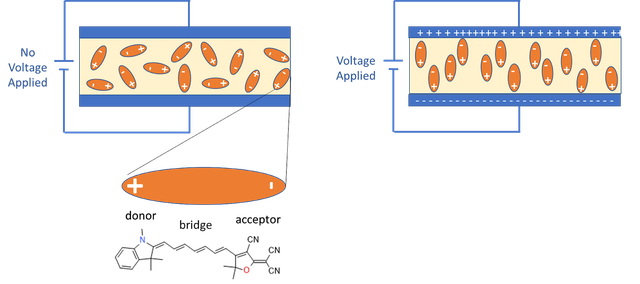
Photo: lightwavelogic.com
Perkinamine chromophores are "poled," or aligned, using a strong electric field combined with heat, then cooled to lock them into an electro-optically active state. Because the polymer's electro-optic activity is set entirely by the direction of the poling field (rather than being fixed by crystal structure, as with rival materials), Lightwave's modulators can use a push-pull design that doubles the effect for the same drive voltage — part of the Company's pitch for lower power consumption in AI data center interconnects. In March 2026, the Company announced modulators exceeding 110 GHz bandwidth on Tower Semiconductor's PH18 silicon photonics platform, a milestone that drove a sharp single-day stock move.
Source: Lightwave Logic Q2 2026 earnings presentation (Aug 11, 2026), company press releases, lightwavelogic.com. TAM/SAM figures are management estimates, not independently verified.
Lightwave Logic has expanded its Englewood, Colorado facility by nearly 10,000 square feet, a 70% increase in available space, to support back-end-of-line prototyping, testing and product qualification. Management has said it is making "aggressive assumptions" about winning share in 2027 and 2028 to size the floor capacity, technician headcount, and production equipment needed so the Company is not "caught flat-footed" once a design win requires a rapid production ramp.
The Company's stated strategy pairs continued in-house back-end-of-line capacity in Denver for prototyping and final qualification with one or two external foundry partners providing high-volume manufacturing scale, targeted for 2026-2027. This dual-track approach is designed to let Lightwave avoid the capital intensity of owning a full-scale fab while still controlling the critical early stages of process development.
Source: Lightwave Logic Q4 2025 and Q2 2026 earnings calls (marketbeat.com, investing.com transcripts), company press releases. Production ramp timing is a forward-looking target set by management, not a guarantee.

Push-pull Mach-Zehnder modulator design. Photo: lightwavelogic.com
Full-year 2025 revenue was approximately $237,000, up from $96,000 in 2024 — a large percentage increase off a very small base, driven primarily by licensing and non-recurring engineering (NRE) fees rather than product sales. The 2025 net loss was roughly $20.3 million. First-half 2026 losses widened further: Q1 2026 posted a $6.3 million net loss, and Q2 2026 widened to $6.6 million, for a combined first-half loss near $12.9 million against combined first-half revenue in the tens of thousands of dollars.
Source: Lightwave Logic Q1 and Q2 2026 earnings calls, FY2025 10-K figures via stockanalysis.com and marketbeat.com. Price-to-sales figure is approximate and moves with the stock price.
Unlike many pre-revenue technology companies, Lightwave Logic is not financially fragile in the near term. It carries no debt and ended Q2 2026 with a substantial cash and marketable securities position, giving management real runway to fund the 2027 production ramp without an immediate financing crunch. That said, a large cash balance funding years of continued losses is a very different thing from a company generating cash from operations — the clock is still running.
How the Cash Has Been Raised
Source: Lightwave Logic Q2 2026 earnings call transcript (investing.com), marketbeat.com balance sheet data.





Source: lightwavelogic.com executive team and board of directors pages; company press releases on CEO and CFO transitions (Dec 2024, Jan 2026, Jul 2026).
Company Website: lightwavelogic.com
SEC EDGAR Filing History: All LWLG Filings
Investor Relations: Investors Overview
Technology Overview: Perkinamine Electro-Optic Polymers
Company Headquarters: 369 Inverness Pkwy, Suite 350, Englewood, CO 80112-6039 — (720) 340-4949
Summary
Lightwave Logic, trading around $6.19 with a market cap near $954 million as of August 21, 2026, has a genuinely differentiated technology story: three decades of electro-optic polymer development have produced Perkinamine, a material now embedded in four active foundry Process Design Kit partnerships, with a March 2026 milestone of 110+ GHz modulators on Tower Semiconductor's platform and five customers advancing through prototype and testing stages. The balance sheet is a real strength here — $95.9 million in cash, zero debt, and management's stated runway into 2028 mean this is not a company facing a near-term financing crisis. But the commercial reality remains stark: Q2 2026 revenue was just $33,000, full-year 2025 revenue was under $250,000, and the roughly $954 million valuation implies a price-to-sales ratio in the thousands, pricing in a 2027 production ramp that management itself has called an "aggressive assumption" for planning purposes rather than a locked-in customer commitment. This is a stock priced almost entirely on a multi-year technology and commercialization thesis, not on current financial performance, and that gap between narrative and numbers is the central thing to weigh before making any decision.
Share this on social media ... and Share with friends:


Liked This Report?
DDAmanda tracks 100+ stocks like this one — with AI-powered dilution alerts, daily scans, and research just like what you just read.
See What Else We're Tracking →Disclaimer: This report is for informational and educational purposes only and does not constitute investment advice. It is not to be considered as an offer to buy or sell securities of any type. Lightwave Logic remains a development-stage company that has generated minimal product revenue over more than three decades of operation, and its current market capitalization implies significant future commercial success that has not yet occurred. Total addressable market and serviceable addressable market figures cited in this report are management estimates and have not been independently verified. Foundry partnerships, customer engagement stages, and production-ramp timelines described in this report are based on company disclosures and are forward-looking; there is no guarantee that design wins will convert into meaningful revenue or that the targeted 2027 production ramp will occur as described. Nasdaq-listed small-cap technology stocks, particularly those trading at high price-to-sales multiples relative to current revenue, are highly speculative and carry significant risk of substantial loss, including from valuation compression if commercialization milestones are delayed or not achieved. This report is compiled from public sources including SEC filings, company earnings calls, press releases, and lightwavelogic.com; DDAmanda has not independently verified all company statements or characterizations. Always do your own due diligence and consult with a licensed financial advisor before making investment decisions. Data current as of August 22, 2026.