


You can pick a stock with a great chart, strong volume and a good story, and still lose money because the company sold a pile of new shares right after you bought. That is dilution, and it is one of the most common ways traders get hurt.
This page explains what dilution is, the filings that give it away, and how DDAmanda’s Dilution Tracker warns you with a simple score before you click buy.
What Is Stock Dilution?
Dilution happens when a company creates new shares. Each existing share then owns a smaller slice of the company, and the new supply of shares often pushes the price down.
How Companies Dilute Shareholders
- Public offerings: the company sells a block of new shares, usually at a discount to the market price.
- At-the-market (ATM) programs: the company sells new shares into the market a little at a time, often without a loud announcement.
- Shelf registrations: a filing that pre-approves the company to sell shares later. It gives the company the option to sell whenever it chooses.
- Convertible notes and warrants: debt or rights that turn into new shares later.
- More authorized shares: shareholders vote to let the company issue more stock.
- Reverse splits: the share count drops and the price goes up on paper, but a reverse split often shows up next to an offering, so it is a flag worth checking.
Why It Matters to Traders
A stock can run for weeks and then drop fast when an offering prices below the market. Traders who never checked the filings are surprised. Traders who checked often saw the warning signs days earlier.
Where the Warning Signs Are Filed
Everything a public company does with its shares has to be filed with the SEC. These are the filings to know:
- 8-K: a current report. Offerings, reverse split approvals and share authorizations show up here.
- 6-K: the same idea for foreign companies listed in the US.
- S-3: a shelf registration.
- 424B: the prospectus for an offering, filed when shares are being sold.
You can read these on the SEC’s EDGAR site. The problem is time. Reading every filing for every stock on your list is slow, and the important line is often buried deep in the document.
How the DDAmanda Dilution Tracker Works
DDAmanda reads the company filings for you. The AI rates each filing, and the tracker adds up the warning signs into one Dilution Risk score. When you look at a stock, a Dilution Warning box tells you where it stands, with the filing dates and what each filing said.
Here are three real warning boxes, shown the way members see them.
Moderate risk: a reverse split was authorized
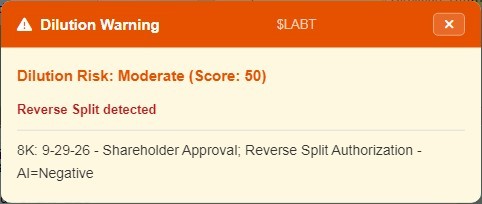
Shareholders approved a reverse split. By itself that is a caution flag, not proof of an offering, so the score is Moderate.
Heavy risk: a reverse split and an offering
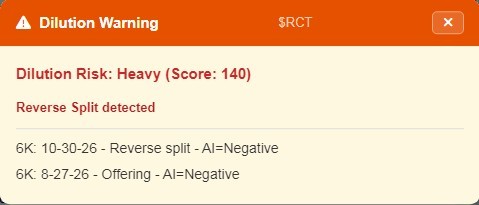
This one has an offering and a reverse split in the filings, both rated negative by the AI. The score climbs to Heavy. These are the stocks traders get burned on when they only look at the chart.
Clean: nothing flagged
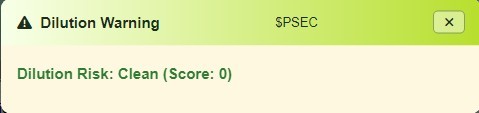
A clean score means the tracker found no dilution warning signs in the filings it reads. That is useful to know before you buy.
These tickers show how the warning reads. They are examples, not recommendations, and nothing on this page is investment advice.
Check Dilution Before You Buy
The Dilution Tracker is included with your DDAmanda membership.
Get Started with DDAmanda 30-Day 100% Money-Back GuaranteeA Quick Dilution Checklist
Before you buy any stock, run through these:
- Has the company filed an offering, an ATM or a shelf registration in the last few months?
- Did shareholders approve a reverse split or more authorized shares?
- Does the company have convertible notes or warrants waiting to turn into shares?
- Is the company burning cash with little in the bank? Companies that need cash sell shares.
- Is the stock running on news the same week a filing shows up?
If you answer yes to more than one, treat the stock with extra care. The tracker does this check for you and gives you the answer as a score.
Frequently Asked Questions
What is a dilution tracker?
A dilution tracker watches company filings for signs that a company is creating new shares, such as offerings, ATM programs, shelf registrations, convertible notes and reverse splits, and reports them to you in one place.
Is a reverse split always bad?
No. A reverse split is not dilution by itself. It is a flag, because it often appears next to offerings, so it is worth checking the other filings.
How does DDAmanda score dilution risk?
The AI reads each filing and rates it. The tracker then adds the warning signs into one score, shown as Clean, Moderate or Heavy, with the filing dates listed underneath.
Where do I see the Dilution Warning?
Inside DDAmanda, when you look at a stock. It opens as a warning box with the score and the filings behind it.
The Bottom Line
A good chart does not protect you from a company that is selling shares. Checking dilution before you trade takes a minute with the right tool, and it keeps you out of the trades that look great right up until the offering prices.